
 English
 Deutsch
 한국어
한국어 Русский
 Français
 日本語
日本語 لالعربية
 हिन्दी
 Español
 Português
 繁体中文
繁体中文 简体中文
简体中文

















產品
Hazardous & Industrial
IP Communication
 知識
知識
2026-02-11 11:07:04
How to Enhance Video Capabilities in Unified Communications?
Elevate unified communications video capabilities with Becke Telcom’s video gateway—supporting multi-protocol conversion, seamless device integration, and real-time transcoding. Optimize emergency command and cross-system video convergence efficiently.

貝克電信
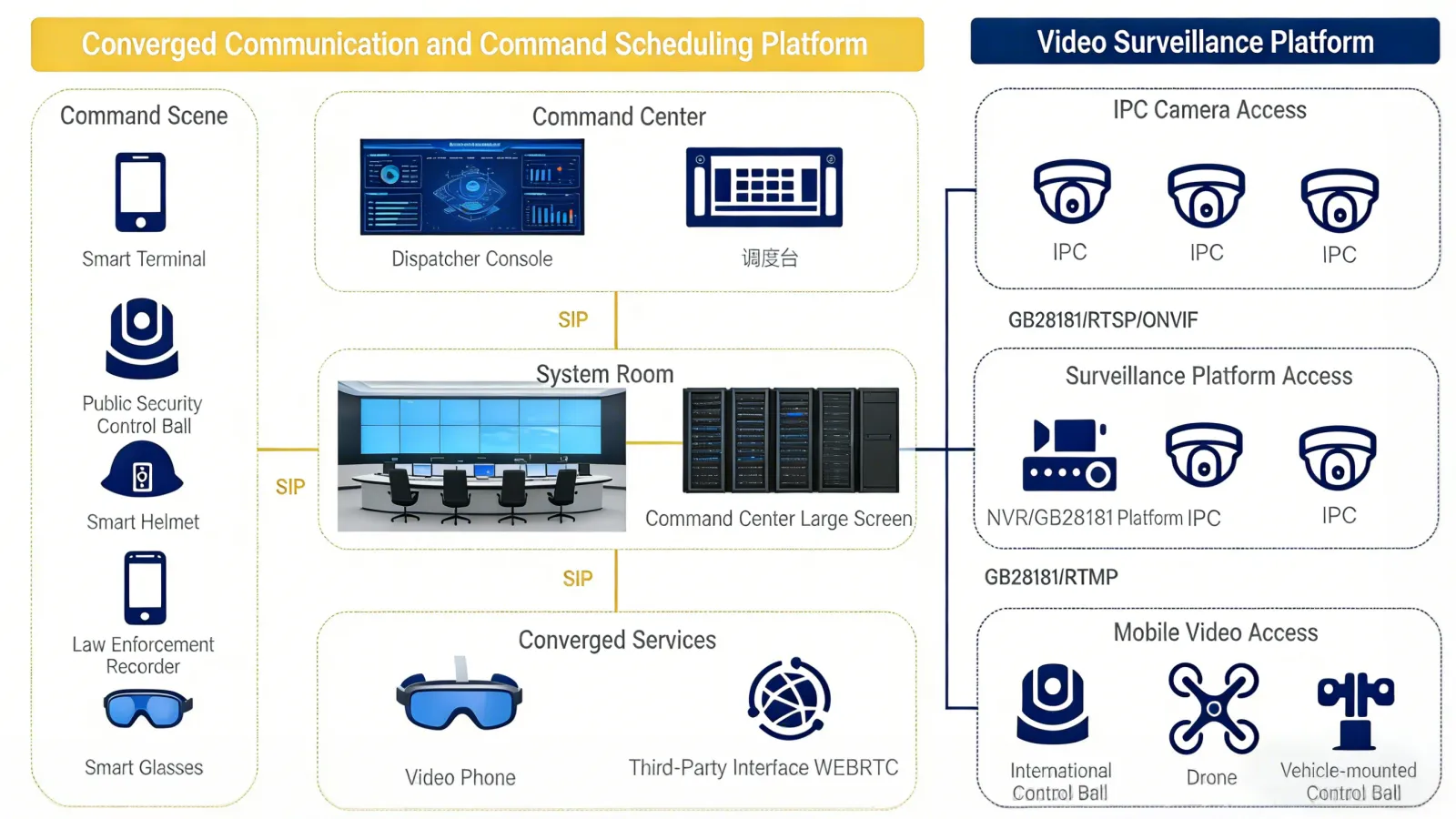
Unified communications has evolved from a focus on audio integration to a comprehensive video-centric ecosystem, driven by the growing demand for visual collaboration across industries, especially in emergency command, public safety, and enterprise operation. The core value of unified communications lies in integrating disparate audio and video systems to enable seamless interconnection, but the proliferation of heterogeneous devices and proprietary protocols has created significant integration challenges for project implementers. Developing custom integration solutions for each device or protocol not only consumes substantial resources but also results in poor scalability and stability.
Becke Telcom’s video gateway addresses these pain points by providing a standardized, scalable solution for video convergence in unified communications. Built on the foundational Session Initiation Protocol (SIP) for unified communications, this video gateway unifies the access of multi-protocol video devices, converts heterogeneous video streams into SIP-compatible video flows, and enables real-time transcoding and cross-platform adaptation. This article explores the core traits of unified communications, the technical value of video gateways, and the full capabilities and practical applications of Becke Telcom’s video gateway solution for enhancing unified communications video performance.
The Evolution and Core Traits of Modern Unified Communications
Unified communications is a holistic communication architecture that integrates voice, video, data, and multimedia services across different networks and terminals, eliminating information silos between independent communication systems. In its early stages, the focus was on audio convergence—integrating walkie-talkies, satellite communication systems, military telephone lines, radio stations, landlines, and mobile phones into a single audio ecosystem via SIP-based voice gateways. This integration significantly improved communication efficiency in scenarios such as emergency command, where dispersed teams required real-time audio coordination.
In recent years, however, the demand for video capabilities in unified communications has surged. Industries including public safety, transportation, and energy now require real-time visual situational awareness—such as live feeds from surveillance cameras, drones, and field patrol devices—to support data-driven decision-making. In emergency command scenarios, for example, video convergence enables command centers to obtain real-time on-site visuals, coordinate rescue teams dynamically, and reduce response times to critical incidents. This shift from audio to video convergence has become the defining trend of modern unified communications, but it also introduces new technical challenges: the diversity of video devices and protocols has made integration far more complex than audio convergence.
SIP as the Fundamental Protocol for Unified Communications
The scalability and openness of SIP are the cornerstones of modern unified communications. As a standard application-layer protocol for initiating and managing real-time communication sessions, SIP supports seamless interconnection between different communication terminals and gateways, making it the de facto standard for unified communications architecture.
SIP-based voice gateways have matured into a diverse ecosystem, enabling integration with traditional telephone systems, walkie-talkies, audio amplifiers, and public address systems with minimal configuration. This maturity has made audio convergence a relatively straightforward process for unified communications projects. The gap, however, has been in video convergence: until recently, there was a lack of a standardized gateway solution to unify the access of multi-protocol video devices and convert their streams into SIP-compatible video flows that can be natively utilized by unified communications systems. Becke Telcom’s video gateway fills this critical gap, bringing the same level of simplicity and scalability to video convergence as SIP voice gateways have to audio convergence.
What Is a Unified Communications Video Gateway? Core Functions and Device Support
A unified communications video gateway is a dedicated network device designed to solve the problem of heterogeneous video device integration in unified communications systems. Its core function is to provide unified access for video devices with different protocols and convert their native video streams into SIP-compliant video flows—the standard video format for unified communications. This eliminates the need for custom development for each video device or protocol, streamlining the integration process and reducing project complexity.
Key Core Functions of Becke Telcom’s Video Gateway
- Unified Multi-Device Access: The gateway supports plug-and-play access for a wide range of video capture devices, eliminating the need for proprietary drivers or custom integration code.
- Cross-Protocol Conversion: It converts non-SIP video streams from heterogeneous devices into standard SIP video flows, enabling direct invocation by unified communications systems such as dispatch consoles and video phones.
- Real-Time Video Stream Management: The gateway provides basic video management capabilities including recording, screenshot capture, and stream forwarding, supporting on-demand visual retrieval for command and dispatch scenarios.
- Seamless System Interconnection: It integrates with existing unified communications components such as SIP-based dispatch systems, command and interaction platforms, and video conference systems, forming a closed-loop visual communication ecosystem.
Supported Video Terminals and Devices
Becke Telcom’s video gateway is engineered to support the most commonly used video devices in enterprise and public safety scenarios, covering both fixed and mobile capture equipment:
- Fixed video devices: IPC surveillance cameras, NVR video recorders, and fixed PTZ cloud platforms (supporting national standard GB28181 access).
- Mobile field devices: Drones, law enforcement recorders, Android ball control devices, portable emergency command boxes, and smart helmets.
- Professional communication terminals: Video phones, smart glasses with video capture, and vehicle-mounted video terminals.
All supported devices can be integrated into the unified communications system with simple web-based configuration, with the gateway automatically handling protocol adaptation and stream conversion. This plug-and-play capability drastically reduces the time and resources required for video convergence project deployment.
Deployment and Typical Networking
The deployment of Becke Telcom’s video gateway is designed to be lightweight and scalable, requiring no major modifications to existing unified communications infrastructure. It can be deployed as a standalone device in the system computer room or as a portable module for mobile scenarios such as command vehicles and field emergency command posts. The core deployment principle is to connect all video devices to the gateway first, then integrate the gateway with the unified communications platform—creating a centralized video convergence node that simplifies management and maintenance.
Standard Deployment Process for Common Scenarios
The most common application of the video gateway is integrating unified communications systems with video surveillance systems, which can be achieved via the national standard GB28181 protocol—the industry standard for video surveillance in public safety and government sectors. The standard deployment steps are as follows:
- Gateway Deployment: Install the Becke Telcom video gateway in the unified communications system computer room, connect it to the local area network (LAN), and complete basic network configuration (IP address, subnet mask, gateway).
- Video Device Access: Connect fixed surveillance devices (IPC cameras, NVRs) to the gateway via the GB28181 protocol; for mobile devices such as drones and ball control devices, access the gateway via RTSP/RTMP protocols over 4G/5G or Wi-Fi.
- Unified Communications Platform Integration: Connect the video gateway to the SIP-based unified communications platform, and configure the gateway as a dedicated video resource node in the platform.
- Stream Invocation Configuration: Map the video devices connected to the gateway to unique SIP numbers in the unified communications system, enabling one-click call and viewing of video feeds via dispatch consoles, video phones, or unified communications apps.
This deployment process ensures that the video surveillance system is fully integrated into the unified communications ecosystem, with command center staff able to retrieve real-time surveillance feeds without switching between different software platforms or devices.
Typical Networking Architecture of the Video Gateway
Becke Telcom’s video gateway adopts a distributed access, centralized management networking architecture, which is highly adaptable to both fixed command centers and mobile field scenarios. The core of the architecture is the conversion of video device resources into SIP-addressable video resources:
- Fixed Command Center Scenario: The gateway is deployed in the central computer room, connecting to the GB28181-based video surveillance platform and SIP-based unified communications platform simultaneously. All surveillance cameras are assigned unique SIP numbers, and dispatch consoles in the command center can directly call camera feeds by dialing these numbers—just like making a regular video call.
- Mobile Field Scenario: A portable version of the gateway is integrated into emergency command boxes or command vehicles, connecting to field devices such as drones and law enforcement recorders via 4G/5G or satellite communication. The gateway converts the video streams of these mobile devices into SIP flows and transmits them back to the remote command center via the unified communications network, enabling real-time visual monitoring of the field situation.
In both scenarios, the video gateway acts as a bridge between heterogeneous video devices and the unified communications system, ensuring low-latency, stable video transmission and one-click invocation of video resources.
Video Gateway: Multi-Protocol Support and Real-Time Transcoding
The competitive advantage of Becke Telcom’s video gateway lies in its comprehensive multi-protocol support and flexible real-time transcoding capabilities, which enable it to adapt to the diverse protocol environments of modern video systems and the heterogeneous terminal requirements of unified communications. Unlike single-protocol video gateways on the market, Becke Telcom’s solution supports both industry-standard and proprietary video protocols, making it a truly universal video convergence solution.
Multi-Protocol Inbound and Outbound Support
The gateway provides full coverage of mainstream streaming media protocols for both video input and video output, ensuring seamless integration with almost all modern video devices and systems.
Supported Inbound Protocols (Video Device Access):
- Industry standard protocols: RTP, RTSP, RTMP, GB28181, SIP
- Surveillance-specific protocols: ONVIF (for interoperability with third-party surveillance cameras)
This wide range of inbound protocols allows the gateway to connect to almost all video capture devices on the market, from standard IPC cameras to professional field devices such as drones and ball control devices that use RTMP for low-latency transmission.
Supported Outbound Protocols (Video Stream Output):
- Core unified communications protocol: SIP
- Industry standard streaming protocols: RTP, RTSP, RTMP, GB28181
- Web and mobile-friendly protocols: WebRTC, FLV, HLS
- National surveillance standard: GB28181
The diverse outbound protocols enable the gateway to push video streams to any target system, not just SIP-based unified communications platforms. For example, SIP video phone streams can be pushed to GB28181-based surveillance platforms, and RTMP drone streams can be integrated into SIP video conferences—achieving true cross-platform, cross-protocol video interconnection.
Real-Time Transcoding and Dynamic Video Parameter Adjustment
A critical technical capability of Becke Telcom’s video gateway is its hardware-accelerated real-time transcoding, which allows dynamic adjustment of video parameters to adapt to different network conditions and terminal capabilities. This is especially important for emergency command scenarios, where network bandwidth may be limited (e.g., satellite communication or 4G/5G in remote areas) and terminal devices may range from high-resolution command center large screens to low-bandwidth mobile smart phones.
The gateway supports real-time adjustment of the following key video parameters:
- Coding format: Conversion between H.264 and H.265 (H.265 offers 50% bandwidth savings compared to H.264 at the same resolution).
- Resolution: Adaptive adjustment from 4K down to 480P to match terminal display capabilities and network bandwidth.
- Frame rate: Dynamic adjustment from 60fps down to 15fps to reduce bandwidth consumption while maintaining smooth motion for critical visuals.
- Bit rate: Real-time bit rate throttling to adapt to fluctuating network conditions, ensuring stable video transmission even on low-bandwidth links.
This transcoding capability ensures that video streams from high-end capture devices can be seamlessly displayed on any terminal in the unified communications system, eliminating compatibility issues and ensuring visual situational awareness even in harsh network environments.
Practical Application Scenarios
Becke Telcom’s video gateway is a highly versatile solution that can be integrated into a wide range of unified communications scenarios, with the most significant value realized in emergency command and dispatch, cross-platform video conferences, and mobile field operations. Its flexible deployment options (fixed/portable) and multi-protocol support make it a core enabler of visual unified communications across industries.
Emergency Command and Dispatch: The Core Application Scenario
Emergency command is the primary application scenario for unified communications video convergence, and Becke Telcom’s video gateway addresses the key pain point of on-site visual real-time transmission in this scenario. In emergency events such as natural disasters, industrial accidents, and public safety incidents, the gateway integrates with satellite communication systems, 4G/5G emergency command boxes, and field devices to form a complete visual command ecosystem:
- Field-to-Command Center Transmission: Drones and ball control devices capture on-site visuals and transmit them to the portable gateway in the emergency command box via RTMP; the gateway converts the streams to SIP and transmits them back to the remote command center via satellite or 4G/5G.
- Multi-System Integration: The command center’s SIP-based dispatch system integrates with the GB28181 surveillance platform via the gateway, enabling staff to view both on-site field visuals and fixed surveillance camera feeds on a single large screen.
- Two-Way Visual Collaboration: Video phones in the command center and smart helmets worn by field rescuers are connected via the gateway, enabling two-way video communication and real-time guidance from the command center to field teams.
This integration ensures that the command center has a comprehensive, real-time view of the on-site situation, enabling data-driven decision-making and dynamic resource allocation—significantly improving the efficiency of emergency response.
Cross-Platform Video Conference and Resource Sharing
Becke Telcom’s video gateway breaks down the protocol barriers between different video conference systems, enabling cross-platform video resource sharing for unified communications. In enterprise and government scenarios, it is common to have multiple video conference systems (e.g., SIP-based internal systems and third-party cloud-based conference platforms) that operate in isolation; the gateway solves this problem by converting video streams between different protocols:
- RTMP to SIP Conversion: External live video streams (e.g., corporate event live feeds via RTMP) can be converted to SIP via the gateway and integrated into the internal SIP video conference system, enabling all participants to view the live feed in the conference.
- SIP to GB28181 Conversion: Internal video conference streams (SIP) can be pushed to the GB28181 surveillance platform via the gateway, enabling remote viewing by authorized personnel via the surveillance system.
- Web-Based Visual Access: The gateway supports WebRTC output, enabling staff to view unified communications video resources via standard web browsers without installing dedicated client software—improving the accessibility of visual resources.
Mobile Video Access and Field Operations
For industries with extensive field operations such as transportation, energy, and public safety, Becke Telcom’s video gateway enables seamless mobile video access to unified communications systems. Field staff equipped with mobile video devices (e.g., law enforcement recorders and smart glasses) can connect to the gateway via 4G/5G, with their video streams converted to SIP and integrated into the central unified communications platform. This enables:
- Real-Time Field Supervision: Managers in the command center can view real-time visuals from field staff’s devices, ensuring compliance with operational procedures and providing real-time guidance for complex tasks.
- Video Evidence Management: The gateway supports recording of field video streams, with the recorded files stored in the unified communications system’s storage server for later retrieval and analysis—simplifying video evidence management for law enforcement and industrial operations.
- Group Visual Collaboration: Multiple field staff can form a visual collaboration group via the gateway, sharing real-time visuals and coordinating their work—improving the efficiency of field operations such as patrols and maintenance.
Core Advantages
Becke Telcom’s video gateway is not just a simple protocol conversion device; it is a comprehensive video convergence solution that is tailored to the needs of modern unified communications. Its core advantages over traditional integration methods and single-protocol gateways include:
Streamlined Project Integration, Reduced Development Costs
The gateway eliminates the need for custom development for each video device or protocol, reducing the time and resources required for unified communications video convergence projects by up to 80%. Its plug-and-play access and simple web-based configuration enable rapid deployment, even for users with limited technical expertise.
Scalable Architecture, Adaptable to Growing Device Needs
As unified communications systems expand and new video devices are added, the gateway can support seamless access of new devices with just simple configuration—no hardware upgrades or software modifications are required. This scalable architecture ensures that the unified communications system can adapt to evolving video convergence needs without incurring additional integration costs.
Complementary to Existing Unified Communications Product Lines
Becke Telcom’s video gateway is designed to be fully compatible with existing SIP-based unified communications components (e.g., voice gateways, dispatch consoles, and video phones), filling the video convergence gap in traditional unified communications product lines. It can be integrated into existing systems as a dedicated video resource node, forming a complete audio-visual unified communications ecosystem.
Deep Integration with Dispatch Consoles, Enhanced Visual Experience
The gateway supports WebRTC and other streaming media protocols, enabling deep integration with unified communications dispatch consoles. Dispatch staff can view, switch, and record video feeds directly from the dispatch console interface, with no need to switch between different software platforms. This deep integration significantly improves the operational efficiency of command center staff and enhances the overall visual experience of the unified communications system.
Support for Mobile and Portable Deployment, Adaptable to Field Scenarios
Unlike fixed video gateways that are limited to the computer room, Becke Telcom offers a portable version of the gateway that can be integrated into emergency command boxes and command vehicles. This enables video convergence in mobile field scenarios, addressing the critical need for on-site visual transmission in emergency command and field operations.
Conclusion
Video convergence has become the core direction of modern unified communications development, driven by the growing demand for visual situational awareness across industries. However, the diversity of video devices and protocols has created significant integration challenges for unified communications projects, with custom development solutions being inefficient and unsustainable. Becke Telcom’s video gateway solves these challenges by providing a standardized, scalable video convergence solution built on the SIP protocol—the foundation of unified communications.
With its comprehensive multi-protocol support, real-time transcoding capabilities, and flexible deployment options, Becke Telcom’s video gateway enables seamless integration of heterogeneous video devices into unified communications systems, converting non-SIP video streams into standard SIP video flows that can be directly invoked by dispatch consoles, video phones, and other unified communications terminals. It streamlines project integration, reduces development costs, and fills the video convergence gap in traditional unified communications product lines—becoming a core enabler for enhancing the video capabilities of unified communications systems.
In emergency command, enterprise operation, and field operation scenarios, Becke Telcom’s video gateway forms a complete visual communication ecosystem, enabling real-time visual transmission, cross-platform resource sharing, and two-way visual collaboration. As unified communications continues to evolve toward video-centric and mobile-centric development, Becke Telcom’s video gateway will play an increasingly important role, helping organizations build more efficient, intelligent, and visual unified communications systems and unlock the full potential of visual collaboration.
標籤:
相關新聞
2026-09-29
2026-09-22
2026-08-31
2026-08-24
2026-08-17


電子郵件地址:
熱線電話: